
Two Young Men, Sepia to Colour
A grainy, low-contrast sepia print is a harder starting point for colour than a clean black and white one, and it is worth explaining why.
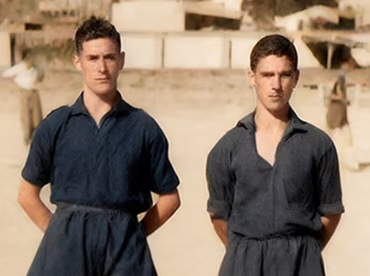
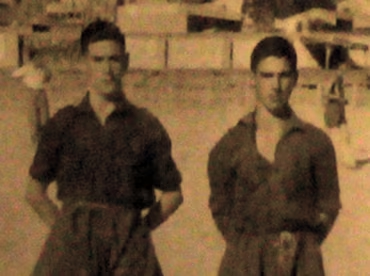
Drag the handle to compare the original with the restored version.
The photograph
Two young men standing outdoors in work clothes, with buildings and open ground behind them. Mid twentieth century, and from the light, somewhere warm.
The damage
The print had faded to a pale, flat sepia with pronounced grain. Faces were soft and low in contrast, edges had begun to break up, and there was very little tonal separation between the men's clothing and the ground behind them.
The work
Grain has to be handled before colour, or the colour sits on top of the noise and the result looks like a tinted photocopy. I rebuilt the tonal separation first, then recovered as much facial detail as the original would give. The colourisation used the greyscale values themselves as evidence: the darker shirt reads as a saturated navy, the lighter one as a mid grey-green, and the ground as pale dry sand. Where the original gives no clue, I say so rather than inventing certainty.
This was a black and white photo colourisation job — see more on black and white photo colourisation.
| Service level | Restoration with colourisation |
| Price band | £30+ |
| Turnaround | 2 days |
Other Restorations
Torn Baby Portrait Rebuilt from Fragments
One of the most damaged photographs I have worked on, and proof that a print in this condition is not beyond saving.
A Colour Print Lost Under a Yellow Cast
Colour prints from the 1970s and 1980s fail in a very particular way, and it looks far worse than it actually is.
An Edwardian Child Portrait in Colour
Seeing a child from a hundred years ago in colour is the moment most clients tell me they had not expected.
Have a photograph like this?
Send me a scan or a clear phone photo. I will tell you honestly what can be recovered, and what it will cost, within three hours.