

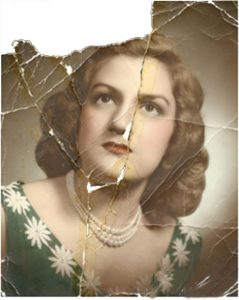
There’s something special about a vintage portrait. It’s not just a picture—it’s a piece of history, a memory frozen in time. When I received this portrait of a young woman, it was faded, with scratches and discolouration that made it hard to see the details. I knew I had to approach it carefully. This wasn’t just about fixing the image; it was about bringing back the story it held.
What was restored
The portrait was a black-and-white image of a young woman in a dark top with a light collar. The clothing and hairstyle suggested it was taken in the mid-20th century. The image had faded significantly, with some areas losing their original detail. There were also scratches and discolouration that made the photo look older than it was. The goal was to bring it back to life without losing the original character.
The restoration process
I started by assessing the image to understand what needed to be done. I looked at the overall quality, the level of damage, and the type of details that had been lost. I made a list of the improvements I could realistically make. This included softening scratches, balancing contrast, and adding natural colour to the image. I took care to preserve the original character of the photo, ensuring that the restoration felt authentic.
One of the key aspects of the restoration was colourisation. I added colour to the image in a way that respected the original tones and textures. I focused on natural skin tones and carefully chose colours for the clothing to match the time period. This helped bring the image to life without making it look artificial or overdone.
Another important part of the process was enhancing the contrast and sharpness. I adjusted these elements to make the image clearer and more detailed, while still maintaining the soft, vintage feel of the original. I also made sure to clean up the background, removing any distractions that might have been present in the original photo.
Throughout the process, I kept the original character of the image in mind. I wanted to make sure that the restoration felt like a natural extension of the original, rather than a completely new image. Every touch was made with care, and every decision was based on the goal of preserving the memory behind the photograph.

Why restoring old photographs matters
Old photographs are more than just images—they are connections to the past. They hold stories, emotions, and memories that can’t be captured in words. When I restore an old photograph, we’re not just fixing a picture; we’re bringing back a piece of someone’s life.
Many people have family photographs that have been damaged over time. These images are often the only visual records of their ancestors, their homes, or their lives. Restoring them allows people to preserve these memories and share them with future generations. It’s a way of keeping history alive, one photo at a time.
Restoration also helps to preserve the original character of the image. This means that the photo remains true to its history, even as it’s made more visible and clear. It’s a balance between enhancement and authenticity, and it’s something that I take great care with in every restoration I do.
There’s also a sense of gratitude that comes from knowing someone has taken the time to care for an old photograph. It shows that the image is valued and that the story it holds is worth preserving. That’s why I always take the time to explain what I can do and what I can’t to ensure that the final result feels right for the person who owns it.
FAQ
- Can you restore any type of old photograph?
I can restore a wide range of old photographs, including black-and-white images, faded prints, and damaged negatives. However, I always assess each image before starting to determine what can realistically be done. Some photographs may not be suitable for restoration due to severe damage or lack of detail. - How long does the restoration process take?
The time required depends on the complexity of the image and the level of damage. Simple restorations can take a few days, while more complex projects may take longer. I always provide an estimate based on the assessment, and I work at a pace that ensures quality without rushing. - Will the restoration change the original character of the photo?
No. My aim is to make the image look natural and preserve its original character. I focus on enhancing details and improving clarity without altering the core of the image. Every decision is made with the goal of respecting the original and making it more visible without losing its authenticity. - Do I need to provide a high-quality scan or photo?
Yes. A clear scan or photo is essential for the restoration process. The better the quality, the more detail I can work with. If the image is too blurry or has poor lighting, it may be difficult to restore accurately. I recommend using a high-resolution scan to ensure the best possible result. - Can you colourise an old photograph?
Yes, I can colourise old photographs with care. I focus on adding natural colours that respect the original tones and textures. This helps bring the image to life without making it look artificial or overdone. I always take the time to explain the colourisation process to ensure the final result feels right.
Conclusion
Restoring a vintage portrait is more than just a technical process—it’s about preserving a piece of history. Each photograph holds a story, and by restoring it, we give that story a chance to be seen again. I take great care in every restoration I do, ensuring that the final result feels true to the original and respects the memory behind it.
Have an old photo that needs restoring?
Send your damaged, faded or torn photograph for a free assessment. Prices start from £9.
- Free assessment before payment
- Natural-looking restoration
- UK-wide digital service